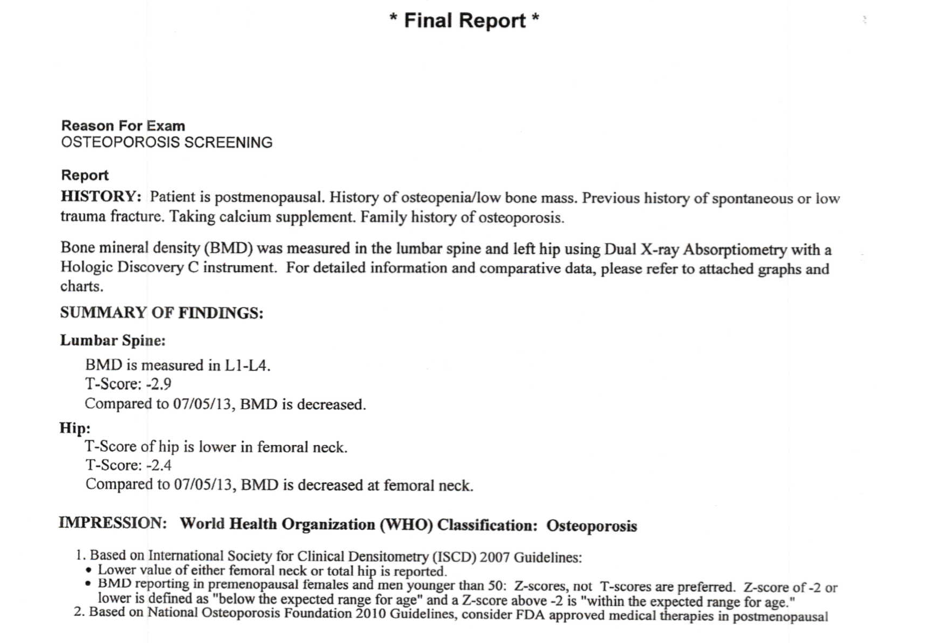
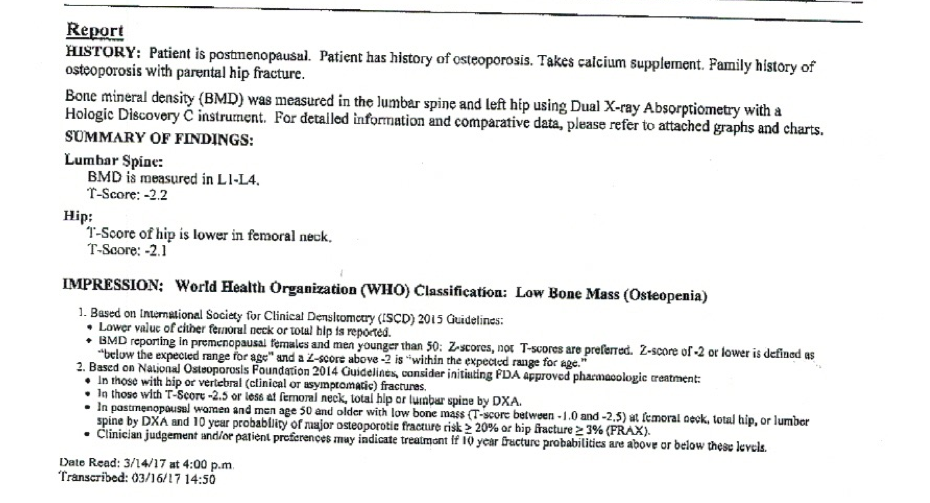
Bone density test results are reported using T-scores. A T-score shows how much your bone density is higher or lower than the bone density of a healthy 30-year old adult. A healthcare provider looks at the lowest T-score to diagnosis osteoporosis.
What Your T-score Means. According to the World Health Organization (WHO):
NORMAL BONE DENSITY: A T-score of -1.0 or above is normal bone density. Examples are 0.9, 0 and -0.9.
LOW BONE DENSITY: A T-score between -1.0 and -2.5 means you have low bone density or osteopenia. Examples are T-scores of -1.1, -1.6 and -2.4.
OSTEOPOROSIS: A T-score of -2.5 or below is a diagnosis of osteoporosis. Examples are T-scores of -2.6, -3.3 and -3.9.
The lower a person’s T-score, the lower the bone density. A T-score of -1.0 is lower than a T-score of 0.5 and a T-score of -3.5 is lower than a T-score of -3.0.